The Latest Theory of Soy Sauce Brewing (1913)
Toganō Meijirō's 469-page foundational treatise — sample from the forthcoming first English edition.
May 30, 2026
This is a sample from the forthcoming first English edition of Saishin Shōyu Jōzō-ron (1913) by Toganō Meijirō — the 469-page treatise that systematized Japanese soy sauce brewing as an industrial science. Coverage: raw material chemistry, koji microbiology, moromi fermentation parameters, complete process flowcharts, equipment design, period photographs of brewing facilities, and regional variations. None of this material has previously appeared in English.
A scarce work — surviving printings are uncommon, and its industrial detail has remained inaccessible to readers without command of pre-modern Japanese.
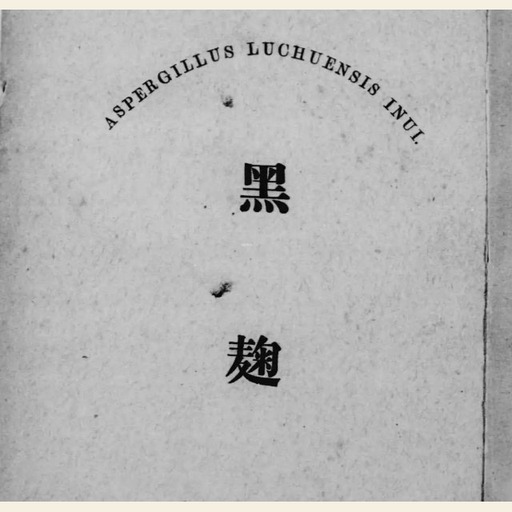
Cover (Page 1)
Saishin Shōyu Jōzō-ron — “The Latest Theory of Soy Sauce Brewing” Toganō Meijirō
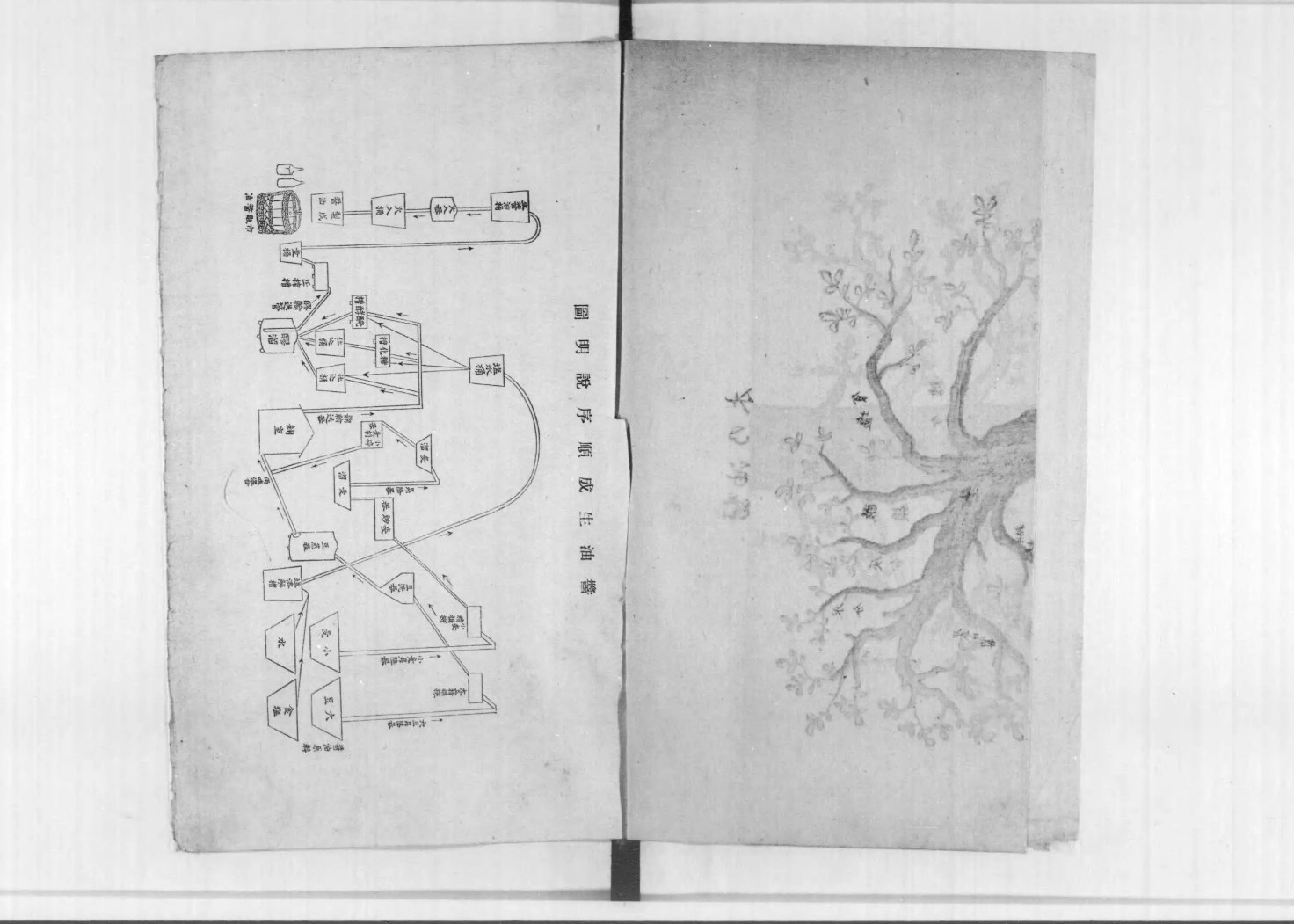
Frontispiece — Production Flowchart (Page 5)
The book opens with a full-page diagram titled 醤油生成順序説明圖 — “Diagram Explaining the Sequence of Soy Sauce Production.”
The flowchart traces the complete pre-modern shōyu manufacturing process in a single integrated view:
[soybean]   [wheat]            (raw materials)
   │           │
   ▼           ▼
[soaking]   [roasting]         (primary preparation)
   │           │
   ▼           ▼
[steaming] [coarse grinding]
   └─────┬─────┘
         ▼
   [koji bed — Aspergillus oryzae]
         │
         ▼                      (with salt brine added)
   [moromi mash — extended fermentation]
         │
         ▼
   [pressing] ───────► [okara residue]
         │
         ▼
   [fire-heating / pasteurization]
         │
         ▼
   [refining / aging]
         │
         ▼
   [bottling / casking]
Adjacent to the flowchart is a botanical drawing of the soybean plant, showing root structure, foliage, and pod morphology — a feature typical of pre-modern Japanese technical books, which placed industrial process and source-plant biology side by side.
Foreword (Page 8) — translated opening
The food of a nation is a question of great importance, even in foreign lands. Within our own country, viewing the matter from the standpoint of national life, the daily food of the people calls for serious consideration. That is to say: the food we eat each day, when investigated and improved, affords great scope for the expression of our national character. Where, beyond mere sustenance, the five flavors are harmonized in the diet and fragrance is added to ordinary food, the pleasure and refinement of the table should be cultivated further still.
(The foreword continues, framing the practical necessity of formalizing the indigenous craft of shōyu brewing as an applied science.)
Photographic Plates (Page 7)
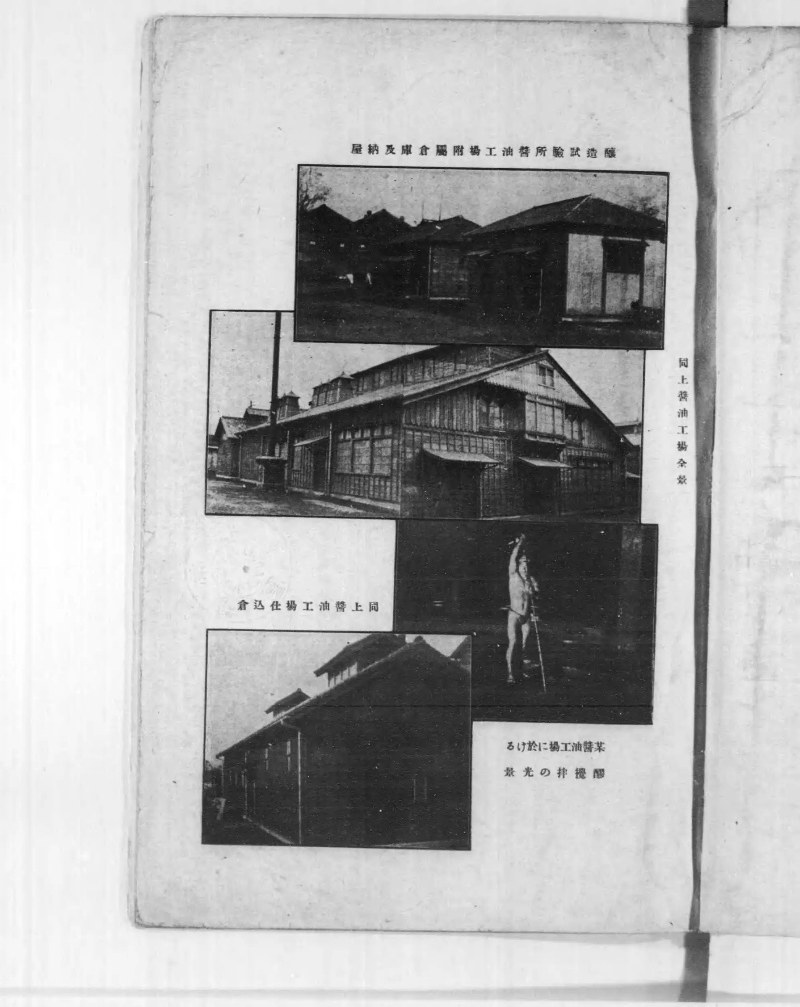
The book includes period photographs of working soy sauce facilities, including:
- Top plate — 「醸造試験所及焙焼工場附属醤油倉庫及納屋」 — Soy sauce warehouse and outbuildings attached to a brewing experiment laboratory and roasting factory.
- Center plate — 「同上醤油工場全景」 — Full view of the same soy sauce factory (showing a multi-story timber-and-tile brewing house with chimney).
- Lower plate — 「同上醤油工場仕込倉」 — Mash-loading storehouse at the same factory.
- Bottom plate — 「某醤油工場に於ける揉桶の光景」 — View of a mash barrel at a certain soy sauce factory (showing a worker standing inside a large vat with a stirring pole).
These photographs document the architecture and human scale of early-twentieth-century Japanese commercial soy sauce production — physical detail that has otherwise been lost from the English-language record.
End of sample
The full English edition will include
- Full translation of all material chapters (~469 pages of original Japanese)
- Reproduction of the complete process flowchart with annotated nodes
- All photographic plates with extended captions and historical context
- Modern annotations on the chemistry (Maillard reactions, amino-acid liberation, ester formation, salt-tolerance microbiology) and process engineering
- Glossary of pre-modern Japanese brewing units with metric conversions
Delivered as HTML, PDF, and Markdown.
To inquire
Write to masae@tokyo-shelf.com with a brief note on your intended use and timeline. I’ll respond with delivery details.
— Masae Sato
Original: Saishin Shōyu Jōzō-ron (最新醤油醸造論), by Toganō Meijirō (1882–1940). Published 1913 (Taishō 2) by Ōtani Shōten. 469 pages with diagrams and photographs.